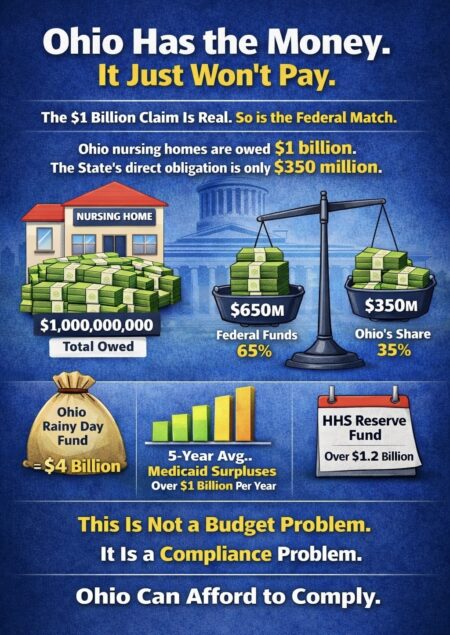
The headlines say Ohio nursing homes are owed $1 billion. That number is accurate. But Ohio's direct obligation — the amount the state must pay from state dollars — is roughly $350 million. Medicaid is a federal-state program. The rest is federal money Ohio is leaving on the table while it defies a court order.
As we documented last week, the Ohio Department of Medicaid has gone more than seven months without complying with a unanimous Supreme Court order directing it to recalculate nursing-facility quality incentive payments. The media attention that followed is welcome. But one important point has not fully surfaced.
The $1 Billion Number Is Real. So Is the Federal Match.
The headline figure has become the starting point for a misleading public discussion about how Ohio is supposed to "come up with" $1 billion. That is the wrong fiscal frame.
As Senate Majority Whip George Lang and Senate President Pro Tempore Bill Reineke have acknowledged, the majority of the owed payments are federally reimbursable. Ohio's direct obligation is only the state-share portion — roughly 35% of the total, or approximately $350 million, with the balance funded through the federal Medicaid match.
This Is Not a Budget Problem. It Is a Compliance Problem.
That amount — while substantial — needs to be understood in context. Ohio's Medicaid program has run an average surplus of more than $1 billion per year over the last five fiscal years. The HHS Reserve Fund - established solely for Medicaid - has over $1.2 billion in it. In addition, the state's Rainy Day Fund carried close to $4 billion through the end of FY 2025. A $350 million state-share obligation is not a fiscal crisis. It is a fraction of what ODM routinely underspends in a single year. Seven months of defiance cannot be explained by fiscal hardship. Ohio can afford to comply.