The title is intentionally provocative. We are not arguing that semiprivate rooms are unlawful, or that Medicaid's shared-occupancy reimbursement policy would fail a constitutional challenge. That is a narrower legal question, and not the one that matters most.
The issue that matters is more basic: In 21st-century America, a nursing-home resident's access to privacy depends substantially on the resident's ability to pay. A resident with money can often pay for a private room, if one is available. A resident who depends entirely on Medicaid usually cannot. Federal Medicaid guidance makes the distinction explicit: unless medically necessary, a private room is something a resident may be charged for separately. In practical terms, privacy becomes something a resident may need resources beyond Medicaid to obtain. The law may permit that distinction. It does not follow that the distinction is right.
We Would Not Design It This Way Today
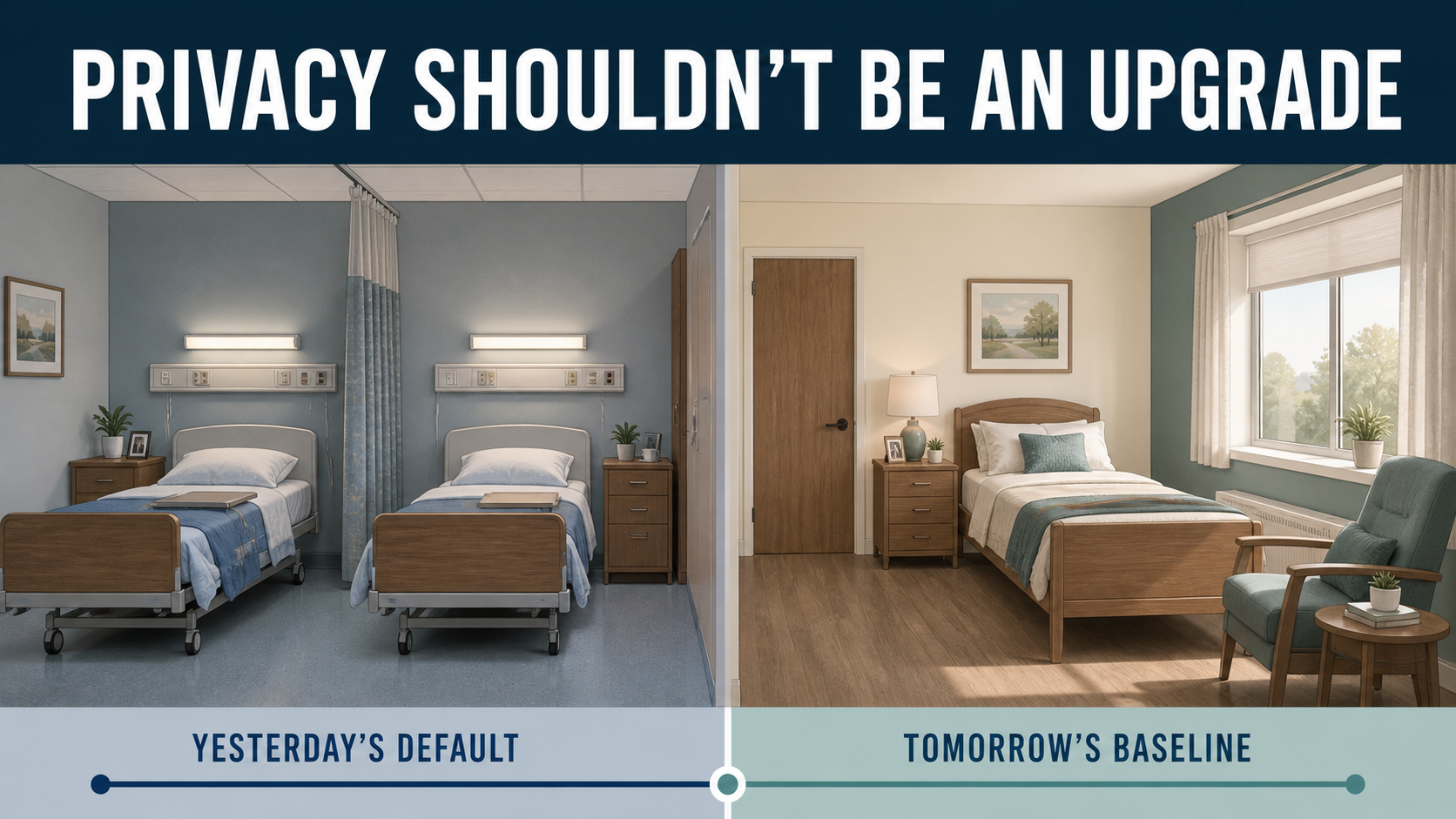
Imagine designing a nursing facility from scratch. Few architects or policymakers would start from the premise that two unrelated adults should sleep several feet apart in the same bedroom, separated by a curtain. But that is what much of America's nursing-home stock still does, because it was built in an era when institutional efficiency drove building design and semiprivate rooms let facilities house more residents on the same footprint.
That model became the default because it already existed, not because anyone concluded it was the right way to house people. Familiarity is not a justification for continuing to build the same way.
Privacy Is Not an Amenity — It Is the Living Condition
A nursing-home room is not a hotel room occupied for a few nights. It is where the resident lives — where they sleep, dress, receive personal care, visit with family, talk with clinicians, and live through some of the most vulnerable years of their life. Room configuration affects more than comfort: it shapes infection control, autonomy, sleep quality, dignity, and a facility's ability to adapt care as a resident's condition changes.
None of this means every resident must live alone; some genuinely prefer a roommate. But there is a real difference between choosing to share a room and having no meaningful alternative because of how care is financed. During COVID-19, research found substantially lower infection and mortality rates in less-crowded nursing-home models than in traditional facilities. Private rooms were only one of several differences between those models, but the experience reinforced the importance of room density and physical design to infection control.
What Is Right — Not What Is Legal — Is the Test
Medicaid policy routinely draws lines around what the program will and will not pay for, and many of those lines are legally sustainable. That does not settle the policy question. A system can be lawful and still deserve to be reconsidered.
The relevant question for policymakers is not whether they can legally maintain a system where private rooms are more accessible to people with more money. It is whether that is the system they should maintain. If two residents require the same level of nursing-facility care, one resident's financial means should not determine whether that resident has meaningful access to privacy and personal space. That is the equity problem, stated plainly.
The Next Generation of Nursing Facilities Should Not Default to Shared Rooms
None of this requires declaring semiprivate rooms inherently bad, and it does not require mandating that every existing facility go all-private immediately. It requires asking what the nursing-home system should look like twenty years from now, as older facilities are renovated, replaced, refinanced, or redeveloped.
The standard worth building toward is not difficult to describe: a private room with a private bathroom as the baseline, not an upgrade tier. Yet our financing system still too often leaves that environment more accessible to residents who can afford to pay beyond what Medicaid provides. Residents who depend on Medicaid deserve meaningful access to the same physical environment available to residents with greater financial resources.
This Is a Choice, Not an Inevitability
A long-term-care system should not keep accepting an outcome where residents with money get a meaningful choice about privacy and residents without money generally do not. That is not a technicality. It is a decision about what kind of system this country is willing to keep building.
The semiprivate room was an understandable product of yesterday's nursing-home system. It should not remain the default for tomorrow's residents.