TL;DR: HUD is updating how Section 232 handles changes in borrowers, operators, and other participants, bringing ownership transfers, operator changes, and management-agent changes into a broader Change of Participants framework. That is the right direction. HUD already has tools to evaluate physical condition and capital needs — Physical Condition Needs Assessments (PCNAs), replacement reserves, survey data, and Life Safety information. As it updates the framework, HUD should add one factor: the age of the facility. A 60-year-old nursing facility carries different physical and capital risk than a facility built ten years ago, even when both have a current PCNA on file.
A Framework Already in Motion
Section 232 sits at the intersection of healthcare and real estate. It finances nursing facilities and other residential healthcare properties while protecting the federal mortgage insurance program behind them. That gives HUD a stake in whether the underlying asset remains physically and financially viable, not just in who owns and operates it.
HUD already has tools built for that: Physical Condition Needs Assessments, replacement reserves, state survey data, and Life Safety Code information.
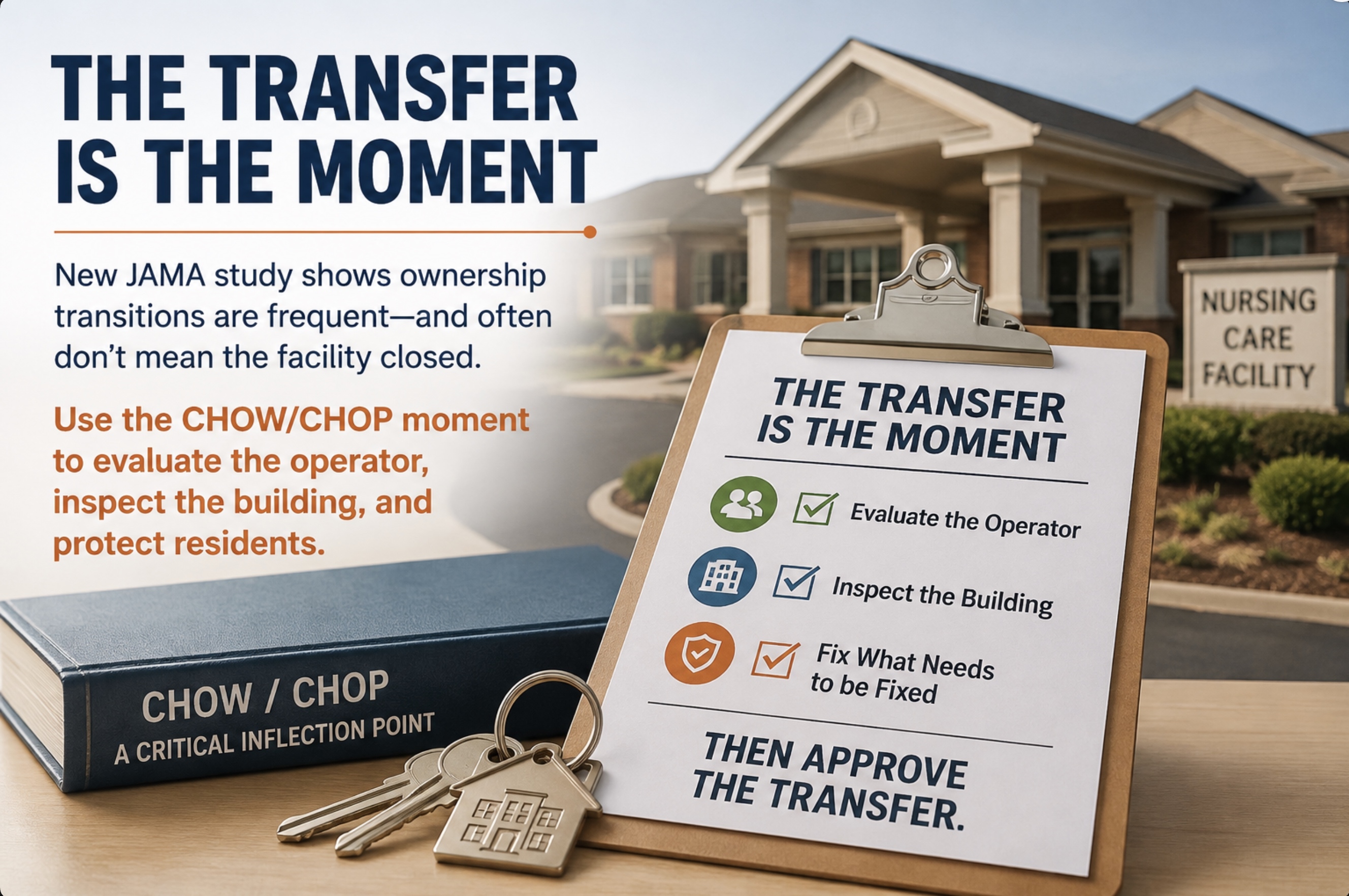
HUD is now updating how it handles changes in the participants responsible for insured projects. The pending revision to the Section 232 Handbook would bring ownership transfers, operator changes, and management-agent changes into a broader Change of Participants framework, with streamlined processes for qualifying transactions.
That consolidation makes sense — and it creates an opportunity.
One Missing Variable: The Age of the Building
HUD already ties physical-condition review to some participant changes. Under the current framework, a change of ownership can require a new PCNA and replacement-reserve analysis when the prior assessment is more than ten years old. The pending revision appears to extend that trigger beyond traditional ownership transfers as part of the broader Change of Participants framework.
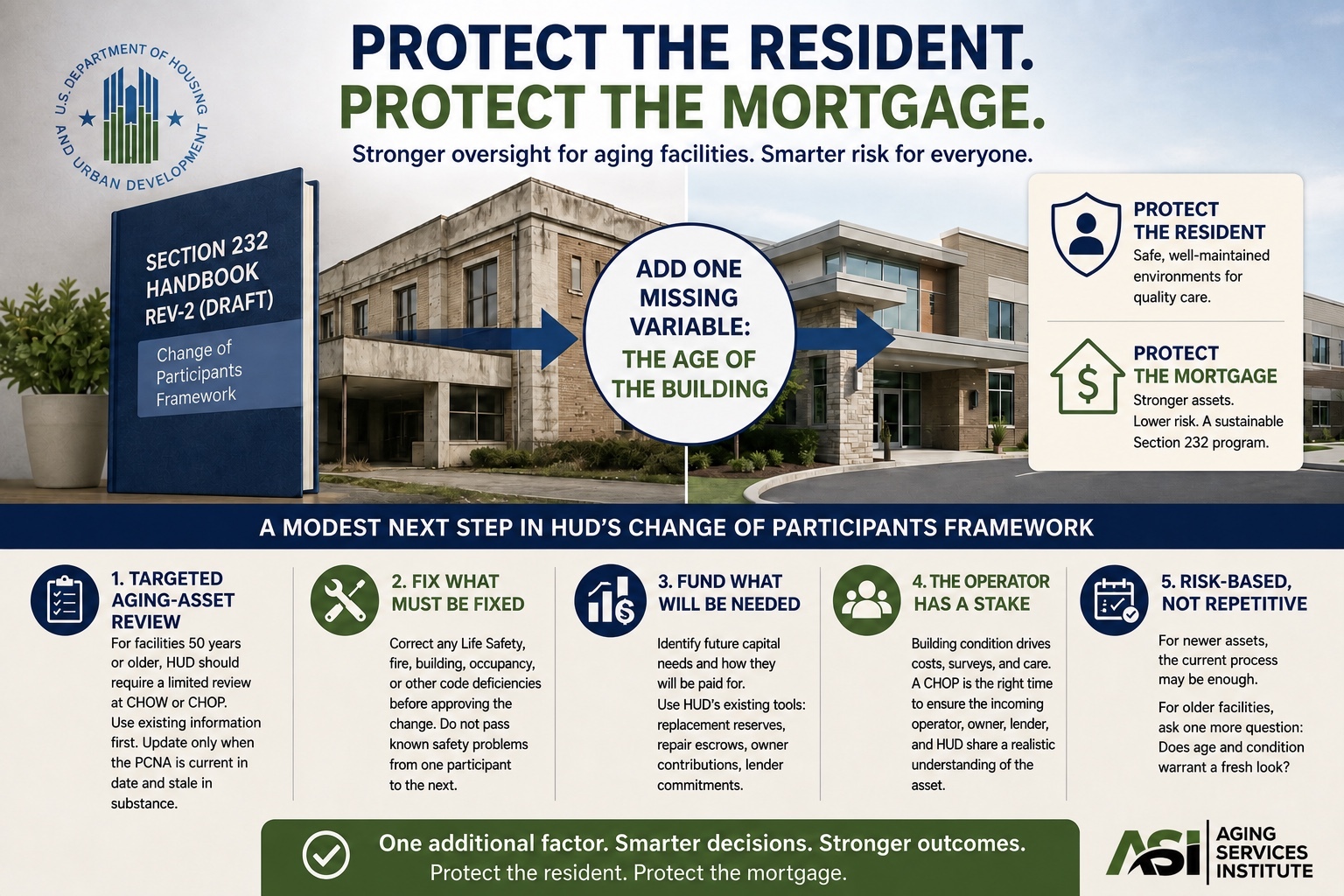
HUD should add another consideration: How old is the building?
A facility built ten years ago and one built in 1968 do not carry the same physical or capital risk simply because both have a PCNA prepared within the last seven years.
Age alone does not mean a building is unsafe, and it should not automatically trigger a new PCNA at every CHOW or CHOP. Older buildings carry more physical and capital risk. Major systems approach the end of useful life. Renovations layer on top of renovations. Capital needs surface that an otherwise current assessment may not fully capture.
A Targeted Aging-Asset Review
For Section 232 nursing facilities at or beyond a defined age threshold — 50 years is a reasonable starting point — HUD should require a limited Aging Asset Review whenever a significant participant change occurs, including a CHOW or CHOP.
This is not a new inspection regime. It starts with information HUD and the lender already have:
- What does the current PCNA say, and when was it completed?
- What major repairs or replacements have occurred since?
- What have subsequent Life Safety, state survey, fire, or building reviews identified?
- Do replacement reserves still reasonably match foreseeable capital needs?
Often, that review will confirm that the existing file is adequate. Stop there.
But when a PCNA is current in date and stale in substance — because conditions have changed, major systems are deteriorating, or reserve assumptions no longer hold up — HUD should require a targeted update or new assessment.
That is risk-based oversight, not process for its own sake.
Fix What Must Be Fixed. Fund What Will Be Needed
An Aging Asset Review should distinguish between two kinds of physical need.
The first is an existing safety or code deficiency. If a facility has a Life Safety, fire, building, occupancy, or similar deficiency that must be corrected for safe and lawful operation: fix it. A participant change should not simply pass a known safety problem from one party to the next.
The second category is different: a roof with five years of useful life remaining, an HVAC system nearing replacement, or other systems functioning today but heading toward a substantial capital expense.
Those systems do not necessarily need to be replaced before HUD approves the transaction. But the transaction should account for what they are likely to cost — and how the project intends to pay for them.
That is what HUD's existing capital tools are for: replacement reserves, repair escrows, owner contributions, lender commitments, or other mechanisms that turn a capital plan into a funded one.
The Incoming Operator Has a Stake, Too
This is not only about protecting HUD's mortgage exposure.
An operator may not own the real estate, but it runs the facility inside it every day. Building condition affects maintenance costs, staffing burden, survey outcomes, insurance, and ultimately the operator's ability to provide care.
HUD already asks whether an incoming operator has the experience and financial capacity to succeed. But even a strong operator can be set up to fail by an aging asset whose capital needs have not been adequately identified or funded.
A CHOP is a natural point to make sure the incoming operator, owner, lender, and HUD share a realistic understanding of the building the operator is taking responsibility for.
A Modest Next Step
HUD deserves credit for updating Section 232's participant-change process. This proposal does not slow that effort down. It makes it more risk-sensitive.
For newer assets, the existing process may be entirely sufficient. For older facilities, HUD should ask one additional question: Does the age and condition of this building warrant a fresh look at its physical and capital needs before responsibility changes hands?
Sometimes the answer will be no — the existing PCNA, reserves, and inspection history will be enough.
Sometimes a 50-, 60-, or 70-year-old building will justify a closer look.
Section 232 protects two things at once: the people who live in the building and the federal mortgage secured by it. As HUD modernizes the program, those interests should move closer together.
Protect the resident. Protect the mortgage.