EXECUTIVE SUMMARY |
Fraud and provider proliferation in home health, hospice, and Medicaid home- and community-based services (HCBS) is not primarily a billing problem. It is a market-design problem — and states created it by treating provider enrollment as an administrative formality rather than a regulatory gate. In high-growth markets, provider counts have expanded without regard to beneficiary need, oversight resources have been spread across an ever-larger denominator, and saturation has become a program integrity warning sign that goes unread. The federal response — enhanced oversight, prepayment review, moratoria, and enforcement takedowns — is real and meaningful. But it operates after markets have already saturated, after questionable providers have already enrolled beneficiaries, and after taxpayer dollars have already flowed. States cannot wait for federal agencies to clean up markets that state approval processes helped create. This brief argues that states should adopt Certificate of Need (CON) or CON-equivalent need-review requirements for home health agencies, hospices, and Medicaid HCBS waiver providers. Access matters. So does accountability. A modern need-review process protects both by ensuring that approved providers are equipped to deliver care, not merely to bill for it. The fraud data, the enforcement record, and the market saturation evidence make the case practical. The coming demographic wave makes it urgent. |
I. The Problem: Unlimited Entry Into Difficult-to-Supervise Markets
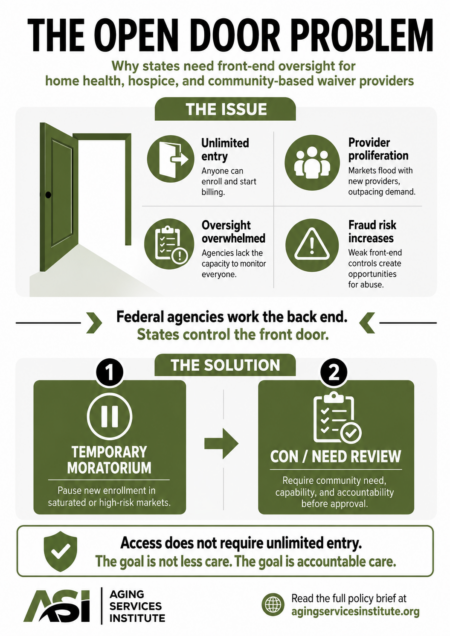
Fraud in community-based care is structural, not incidental. States have built provider categories with low entry barriers, dispersed service delivery, and oversight that cannot scale to match unmanaged growth.
Medicaid home care, hospice, and community-based waiver services share three structural characteristics that make them acutely vulnerable to fraud: services are delivered in private homes and community settings where supervision is inherently limited; payment flows to a large and diffuse provider universe that is difficult to audit systematically; and entry into these provider categories has, in most states, been effectively unlimited. Any applicant who clears minimum licensure requirements gets in. There is no assessment of whether the market needs another provider.
The result is predictable. Provider counts grow without regard to beneficiary need. Oversight resources are spread across an ever-larger denominator. And the signal that should be obvious — a disproportionate number of providers relative to the population served — goes unread.
Ohio: A Case Study in What Unlimited Entry Produces
Ohio illustrates the pattern clearly. The state has over 4,500 companies licensed to provide home health services in the state. Published reports indicate Ohio spent roughly $1 billion on home health services through Medicaid in 2024. The state’s HCBS waiver framework, like that of several other states, permits payment for services delivered in private homes — including services delivered by family members — under a structure where independent verification of service delivery is inherently difficult.
Provider density in some Ohio markets has reached levels that should, on their face, prompt regulatory questions. Media investigations have found concentrations of Medicaid-billing home health entities in single office buildings and single corridors. The pattern is not subtle. It is also not the result of any single bad actor. It is what happens when a state’s approval process asks only whether an applicant meets minimum threshold requirements — and never asks whether the market needs another provider.
States should be sensitive to access. Beneficiaries who need services should receive them. But a state cannot ensure quality, accountability, or program integrity in a provider universe of that size. Oversight resources do not scale to match unmanaged provider growth. Neither do survey schedules, complaint investigations, or audit capacity. When the denominator grows without limit, the practical capacity to supervise it shrinks per provider.
“When the denominator grows without limit, the practical capacity to supervise it shrinks per provider.” |
This is the structural problem need-review is designed to address. Not whether services should exist — they should — but whether the state has any mechanism, before approval, to evaluate whether another provider will actually serve beneficiaries or simply add another billing entity to a saturated market.
National Enforcement Data Confirm the Pattern
Ohio is a concentrated example of a national problem. Federal and state enforcement data document it across all three provider categories addressed in this brief.
FEDERAL ENFORCEMENT SNAPSHOT | |||
200+ Hospice Medicare enrollment revocations in the four original enhanced-oversight states CMS, 2026 | $50M+ Alleged fraudulent hospice activity in OIG enforcement actions in Los Angeles alone HHS-OIG, 2026 | 298 Medicaid fraud convictions involving personal care service attendants in FY 2024 HHS-OIG MFCU Report | 36% Share of all MFCU fraud convictions tied to personal care attendants — more than any other provider type HHS-OIG MFCU Report |
Hospice has drawn particular federal attention. CMS placed newly enrolling hospices and those undergoing ownership changes in Arizona, California, Nevada, and Texas under enhanced oversight beginning in July 2023, and has since expanded the program to Georgia and Ohio. As of June 2025, CMS reported that 668 hospices had been subject to medical review under the Provisional Period of Enhanced Oversight, with 122 revocations at that point. The House Oversight Committee has estimated Medicare fraud in Los Angeles County hospice alone in the billions.
The fraud typology in hospice is well-documented by OIG and includes: beneficiaries enrolled in hospice without their knowledge or under false pretenses; beneficiaries enrolled who were not terminally ill; billing for services not provided; kickbacks to physicians and referral sources; and falsified documentation.
In home health, CMS has previously used temporary enrollment moratoria in high-risk states — Florida, Texas, Illinois, and Michigan — expressly tying the action to fraud, waste, and abuse concerns. CMS’s authority to impose such moratoria is grounded in federal warning criteria that include a highly disproportionate number of providers relative to beneficiaries and a rapid increase in enrollment applications. Those are precisely the conditions emerging in multiple states today.
In Medicaid HCBS and personal care, the enforcement record is substantial. The national Medicaid improper payment rate was estimated at 6.12 percent in fiscal year 2025, translating to $37.4 billion. The MFCU system as a whole produced over 1,100 convictions and $1.4 billion in recoveries in fiscal year 2024 — with personal care service attendants representing the largest single provider category in those convictions.
II. The Current Regulatory Framework Is Necessary but Insufficient
Federal back-end enforcement is real and improving. It also necessarily operates after questionable providers have enrolled and taxpayer dollars have flowed.
Federal and state regulators have not been passive. The tools deployed against home health, hospice, and HCBS fraud are real and, in some instances, effective. They include:
- Provider enrollment screening, background checks, and periodic revalidation
- Electronic Visit Verification (EVV), mandated under the 21st Century Cures Act, requiring verification of time and location before payment for personal care and home health services
- Prepayment review, payment suspension authority, and recovery audit contractors
- CMS moratoria authority for new provider enrollment in high-risk categories and geographies, plus enhanced oversight programs like the PPEO for hospice
- Medicaid Fraud Control Units in all 50 states (and DC, PR and USVI as well) and National Health Care Fraud Takedown operations
These tools are valuable. They catch bad actors. They recover dollars. But they share a common structural limitation: they operate after the problem has already occurred.
Enrollment screening asks whether an applicant meets minimum standards. It does not ask whether the market needs another provider. Licensure confirms operational capacity. It does not evaluate whether adding another provider makes oversight harder without improving access. Fraud investigation recovers some of what was lost. It does not prevent the next wave of fraudulent entrants from applying the following month. |
The federal moratorium standard is instructive here. CMS’s authority to suspend new enrollment in a category is triggered by warning signs that include a highly disproportionate number of providers or suppliers in a particular category relative to beneficiaries and a rapid increase in enrollment applications within a particular category or geographic area. Federal policy already recognizes that provider saturation is itself a program integrity warning sign. States should borrow that logic and build it into their front-end approval processes — before the saturation occurs, not after.
“Federal policy already recognizes that provider saturation is itself a program integrity warning sign.” |
III. Certificate of Need in the Community-Based Care Context
The historical debate over CON has limited bearing on community-based care, where market structure makes need-review a program integrity tool, not a competition restriction.
Certificate of Need programs are not new. New York enacted the first CON law in 1964. Federal requirements in the 1970s drove widespread adoption, and when federal CON requirements were repealed in 1986, states were left to make their own determinations. As of January 2025, 35 states and Washington, D.C. maintain some form of CON program. The scope of these programs varies considerably. Some apply primarily to hospitals and capital-intensive institutional facilities. Others apply CON requirements to home health agencies and hospices directly, but application in this area is rare, e.g., in 2024 approximately 86% of hospices are in states without a hospice CON.
CON has been the subject of policy debate over the past several decades, with arguments made on both sides about its application to various health care sectors. That historical debate, however, has limited bearing on the question this brief addresses. Home health, hospice, and community-based waiver services present a fundamentally different market structure than the institutional sectors where CON has historically been most contested.
The argument for need-review in community-based care turns on a distinct set of market characteristics:
- Entry costs are low (a lease, a license, a few employees, or in some cases, none of the above)
- Services are delivered in dispersed settings that are inherently difficult to supervise
- Billing documentation is often thin and hard to independently verify
- Market saturation does not improve access — it dilutes oversight
- Fraudulent entry is attractive precisely because it is easy
In this context, the question need-review asks — does the community need another provider? — is not about restricting competition. It is about ensuring that the state is approving providers that will actually serve beneficiaries, not just bill for doing so. The federal moratorium standard reflects the same logic: provider saturation is itself a program integrity warning sign, and warrants regulatory attention.
“Market saturation does not improve access — it dilutes oversight. |
EVIDENCE SPOTLIGHT Hospices in CON states show higher quality outcomes A 2024 peer-reviewed study examined 4,870 U.S. hospices and found that those operating in CON states scored significantly higher on standardized quality measures than those in non-CON states. The effect was particularly pronounced for small and medium-sized hospices. CON-state hospices showed higher performance across numerous measures. The researchers concluded that CON regulations had a modest but meaningful positive association with quality outcomes — consistent with the view that limiting market saturation in hospice is not anti-competitive, but protective. Source: 2024 peer-reviewed analysis published in the American Journal of Hospice and Palliative Medicine (Vol. 41, Issue 5), examining 4,870 hospices using Medicare Hospice Item Set quality measures. |
IV. What a Modern Need-Review Framework Should Require
A modern framework should be narrower, more data-driven, and explicitly focused on program integrity. Six elements define it.
1 | Community Need Demonstration Applicants must demonstrate that the proposed service area has unmet need: access gaps, underserved populations, waitlists, or measurable capacity constraints. Where an area already has adequate coverage, the burden is on the applicant to show why another provider serves a distinct population or addresses a distinct access problem. In markets exhibiting clear saturation patterns, the presumption should run against approval. |
2 | Operational Competence Verification Applicants must demonstrate relevant experience, staffing capacity, compliance infrastructure, and financial stability. A new home health LLC with no prior operating history, no identified clinical staff, and no documented compliance program should not receive the same approval pathway as an established nonprofit with an audited track record. Regulators should be permitted to look through nominal ownership to common control relationships, shared management companies, and prior revocations in other states. |
3 | Program Integrity Readiness Applicants must describe how they will monitor visits, prevent overlapping billing, supervise caregivers, respond to complaints, verify service delivery, and comply with EVV and Medicaid documentation requirements. This is not a paperwork exercise. Reviewers should assess whether the applicant has the infrastructure to actually deliver on these commitments — not merely whether they can articulate them. |
4 | Ownership Transparency Applicants must disclose all beneficial owners, related entities, management companies, shared office or billing arrangements, prior sanctions or exclusions, prior revocations in any state or program, and common control relationships. Documented patterns of clustered Medicaid-billing entities sharing addresses, management, or ownership networks illustrate why surface-level entity review is insufficient. Regulators need to see the full network. |
5 | Market Saturation Review States should establish provider-to-beneficiary benchmarks for service areas. Where a county or region already exceeds those benchmarks, new applications should face heightened scrutiny and a rebuttable presumption of denial absent a strong showing of unmet specific need. This replicates the logic of the federal moratorium standard and applies it prospectively. States should not wait for CMS to declare a saturation emergency before acting on patterns that are visible in their own licensing data. |
6 | Post-Approval Accountability CON or need approval should not become a permanent operating entitlement. States should condition continued participation on claims integrity metrics, survey results, complaint history, staffing compliance, EVV adherence, and cooperation with audits. Providers that fail to maintain the standards on which approval was granted should face expedited review and potential revocation. The approval is a grant of trust, not a license in perpetuity. |
V. Demographic Pressure Makes This Urgent
Rising demand will attract legitimate providers — and bad actors. The legitimate providers are the parties most directly harmed by the latter.
None of this analysis operates in a static environment. The U.S. Census Bureau projects that the population aged 85 and older will more than double by 2040. Medicaid HCBS home care users increased by more than 750,000 between 2019 and 2023. As of 2025, more than 600,000 individuals were on waiting lists for HCBS programs nationally. The pressure on community-based care will only intensify.
That demographic reality has two implications that cut in opposite directions. First, access matters. HCBS is essential to the future of long-term care. More people will need home health, hospice, and waiver services. States must ensure that provider supply is adequate to meet that need.
But second, rising demand increases the financial attractiveness of community-based care markets to bad actors. The saturation patterns visible in several states today did not emerge despite Medicaid HCBS expansion — they emerged because of it. Markets that are already saturated will become more so as federal and state spending on HCBS increases. Fraud patterns currently concentrated in a handful of high-risk markets will migrate, exactly as hospice fraud has migrated from the original enhanced-oversight states to new ones.
Access does not require unlimited entry. A state can ensure robust access to home health, hospice, and waiver services while also ensuring that the providers approved to deliver those services are legitimate, accountable, and actually needed. These goals are not in tension. They are complementary. |
The legitimate providers in these sectors should want higher barriers to entry. They are the parties most directly harmed when bad actors distort referral patterns, recruit beneficiaries improperly, bill for services not provided, and trigger broad enforcement responses that damage the sector’s reputation and invite sweeping regulatory crackdowns.
“Fraudulent entrants are not competitors to legitimate providers. They are a threat to them.” |
VI. Policy Recommendations
Two timelines, two tools. A bridge measure to stop the bleeding. A structural framework to fix the cause.
State legislatures and Medicaid agencies should act on two timelines simultaneously. The structural fix is a need-review framework. The immediate need, in states where saturation is already documented, is to prevent the problem from deepening during the months or years required to draft, pass, and implement that framework.
TRACK 1 Immediate | Time-limited moratorium on new provider enrollment Bridges the gap while CON is drafted, passed, and implemented. Modeled on CMS’s existing federal moratorium authority. |
TRACK 2 Structural | CON or CON-equivalent need-review framework Six-element framework establishing community need, operational competence, program integrity, ownership transparency, saturation review, and post-approval accountability. |
Recommendation | Rationale |
In states with documented saturation patterns, consider time-limited moratoria on new provider enrollment as a bridge measure while a permanent need-review framework is developed | CMS has exercised analogous moratorium authority in home health when saturation and fraud risk warranted it. States facing the same conditions should not leave the front door open during the legislative interval required to enact CON. |
Enact CON or CON-equivalent need-review requirements for new home health agencies, hospice providers, and Medicaid HCBS waiver providers | Licensure confirms minimum standards. Need review addresses whether the market requires another provider. Both are necessary. Neither alone is sufficient. |
Establish provider-to-beneficiary benchmarks and trigger enhanced review when those benchmarks are exceeded in a service area | Saturation is a program integrity warning sign. States should not wait for federal enforcement to act on patterns that are visible in their own data. |
Require full ownership disclosure, including beneficial owners, related entities, shared office arrangements, and common control relationships, as a condition of need-review approval | Documented clustering patterns demonstrate that surface-level entity review is insufficient. Fraudulent networks operate through layered relationships that standard licensure review does not reach. |
Condition continued participation on ongoing performance — claims integrity, EVV compliance, survey results, and audit cooperation — and establish expedited review for providers that fall below those thresholds | CON approval is not a permanent entitlement. Post-approval accountability closes the gap between front-end approval and back-end enforcement. |
Apply heightened need-review requirements to providers seeking approval in markets currently subject to federal enhanced oversight or prior enforcement moratoria | Federal enforcement identifies high-risk markets. State approval processes should incorporate that signal rather than ignore it. |
WHAT STATES SHOULD DO |
□ Audit current home health, hospice, and HCBS waiver provider density by service area against beneficiary population. |
□ Identify service areas where provider-to-beneficiary ratios indicate saturation. |
□ Consider time-limited moratoria on new enrollment in saturated markets as a bridge measure. |
□ Draft CON or CON-equivalent need-review legislation covering home health, hospice, and HCBS waiver providers. |
□ Build the six elements into the statutory framework: community need, operational competence, program integrity readiness, ownership transparency, market saturation review, and post-approval accountability. |
□ Coordinate with the state attorney general and Medicaid Fraud Control Unit on ownership-network analysis and ongoing monitoring. |
VII. Conclusion: States Must Own This Problem
Federal agencies are working the back end. States control the front door.
The fraud concentrated in home health, hospice, and Medicaid HCBS is not a surprise. It is the predictable outcome of market structures that reward easy entry, minimize front-end accountability, and defer oversight to post-payment enforcement. States did not create that structure maliciously. In many cases, they created it with the genuine goal of expanding access to care. But access-oriented policy and program integrity are only in tension when market entry is entirely unmanaged.
Federal agencies are working the problem from the back end. CMS has enhanced oversight, moratoria authority, and enforcement tools. OIG investigates and prosecutes. DOJ takes down fraud networks. Those tools are essential. They are not sufficient.
States control licensure. States control Medicaid provider enrollment. States can see market saturation in their own data before federal agencies declare an emergency. States are not passive spectators to the fraud patterns unfolding in their own markets. They are, in part, the cause of those patterns — and they have the authority to fix them.
Modernized need-review requirements are not a relic of 1970s health planning. They are a practical response to a demonstrated program integrity failure. States can protect access and protect taxpayers at the same time — but only if they regain control of the front door.
States should stop approving all comers. They should start asking whether the market needs another provider before they let one in.