TL;DR: In December 2024, ASI warned that the 5-Star rating system's reliance on historical data locks new facilities out of referral and contracting advantages. CMS's new Risk-Based Survey program, launched in July 2026, now attaches an additional public benefit to having a 5-Star rating — one that new facilities are categorically unable to earn under CMS's own methodology. The problem we identified didn't go away. CMS just raised the stakes.
We Flagged This in 2024
In Incentivizing New Facility Development with Forward-Thinking 5-Star Rating, ASI made a narrow, specific argument: the 5-Star Quality Rating System scores facilities on historical inspection and quality-measure data, which means a newly built, newly certified facility cannot earn a competitive rating in its first years of operation — regardless of how well-designed, well-staffed, or well-run it is. New construction gets penalized for being new. Managed care contracts and referral relationships that key off overall star ratings pass new facilities by, not because of documented quality problems, but because the rating system has no way to measure a track record that doesn't exist yet.
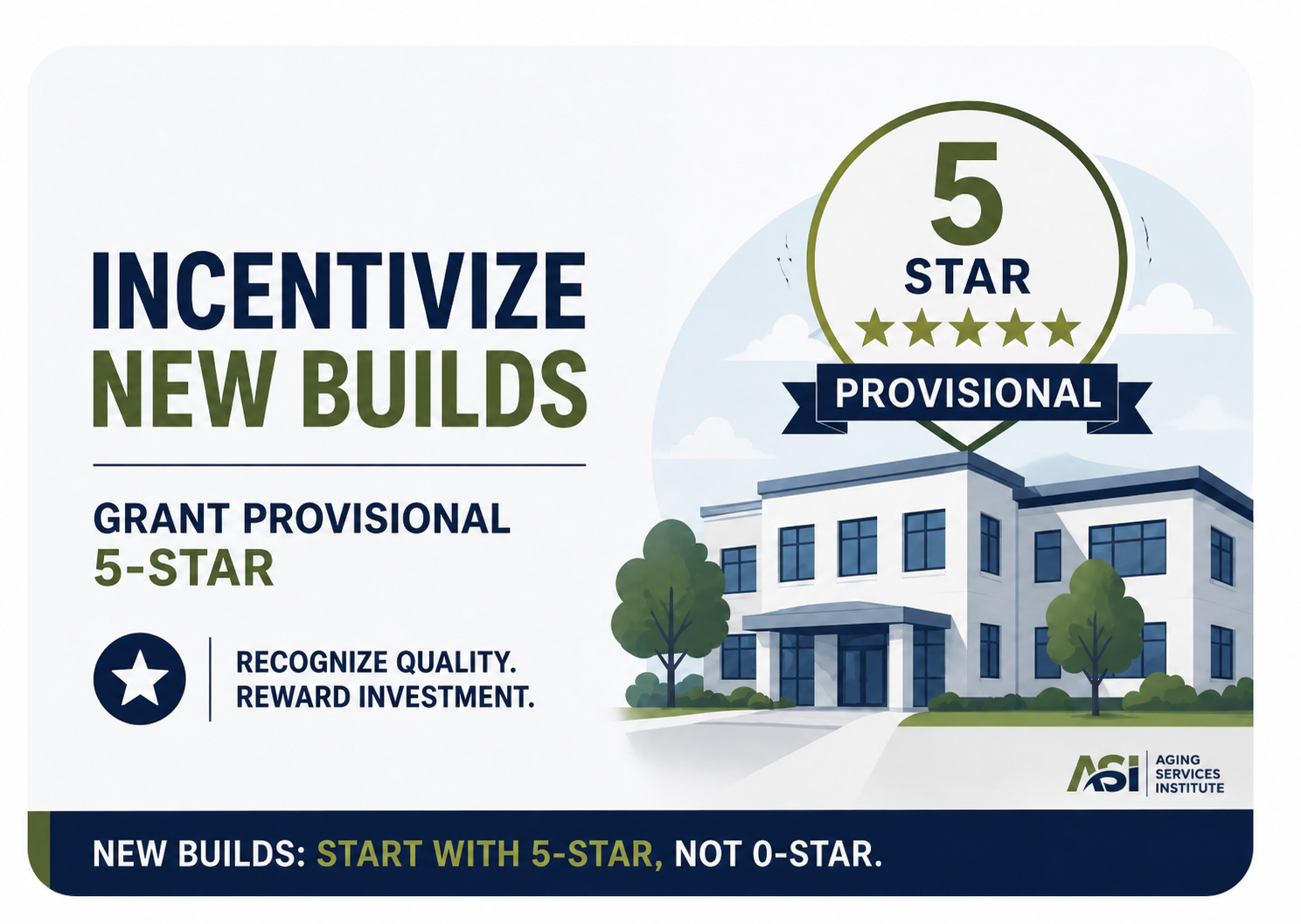
Our proposed fix was a provisional 5-Star designation: earned through demonstrated compliance from day one, revocable immediately on any adverse finding, and converting to a real, earned rating on a fixed schedule. Not a free pass. A bridge — because the overall rating isn't just a consumer information tool. It's the reference point managed care organizations use for network decisions, and in a number of states, it's written directly into Medicaid quality incentive payment methodologies. A facility locked out of a rating is locked out of all three at once.
CMS Just Raised the Stakes on an Old Problem
On July 16, 2026, CMS announced a new Risk-Based Survey (RBS) process for high-performing nursing homes. Facilities that qualify get a streamlined standard survey and a favorable designation on Care Compare, beginning in September 2026.
One of the threshold requirements is an Overall 5-Star rating.
That creates an immediate problem for new facilities — because CMS's own 5-Star methodology does not permit them to have one.
CMS's own Five-Star Technical Users' Guide is explicit about why: a facility needs two standard health inspections before CMS will assign a health-inspection rating. Below that threshold, CMS treats the facility as having "insufficient data" — and withholds not just the health-inspection rating, but the Overall rating and the staffing and quality-measure ratings too, regardless of how strong the underlying numbers are.
So a newly constructed facility can open with a clean certification survey, full staffing, and no harm citations — and still be categorically unable to qualify for CMS's new high-performance designation. Not because CMS found the facility provides inferior care. Because CMS has not yet accumulated enough survey history to rate it at all.
To be clear about what kind of problem this is: CMS isn't imposing a new burden on new facilities. It's creating a new advantage — reduced survey burden and public recognition — that only facilities old enough to have accumulated two standard surveys can reach. New facilities aren't worse off than they were last month. They're further behind a bar that just moved.
RBS bundles two distinct things: a public high-performance designation, and a reduction in survey scrutiny. ASI's concern is with the first. A new facility earning provisional 5-Star status has not yet built the track record that justifies fewer inspections — and shouldn't. What it deserves is accurate recognition of demonstrated compliance, not a lighter survey load it hasn't earned.
That is the exact structural problem ASI identified in 2024. CMS has now attached a second, more immediate benefit to the same broken threshold.
The Fix Doesn't Require CMS to Wait on Congress
CMS's Five-Star methodology is administered and periodically revised by the agency itself through the Technical Users' Guide — most recently in 2025 and again in 2026. Nothing about the structural problem we're describing suggests Congress needs to redesign the statutory framework before CMS can create an appropriate provisional pathway for newly certified facilities. This is squarely within the same administrative process CMS already uses to update how ratings are calculated.
A Provisional Pathway Rewards Compliance, Not Longevity
A facility earns provisional 5-Star status at certification if it clears its first survey within a defined, permissible severity threshold, demonstrates staffing performance meeting a defined provisional standard, and has no substantiated complaint findings above a specified scope-and-severity threshold. That status is not a permanent exemption from accountability. It converts to the facility's actual earned rating on a fixed schedule, and it ends immediately if the facility generates a harm citation or an immediate-jeopardy finding before that conversion date.
That is not a lower bar. It is a different bar, applied to a population the current system was never built to measure.
CMS says it wants to reward strong providers and encourage the rest to improve. Purpose-built new facilities are precisely the kind of investment public policy should encourage — yet the rating system denies them any way to establish 5-Star standing until sufficient survey history accumulates.
The Ask
CMS should not use the absence of history as evidence of the absence of quality. A provisional 5-Star pathway would let new facilities earn the recognition and referral standing that rating unlocks. It would not make them eligible for RBS. Provisional facilities should remain on the standard survey track — full inspections, standard cadence — until they've earned, through actual performance, the reduced scrutiny RBS reflects.